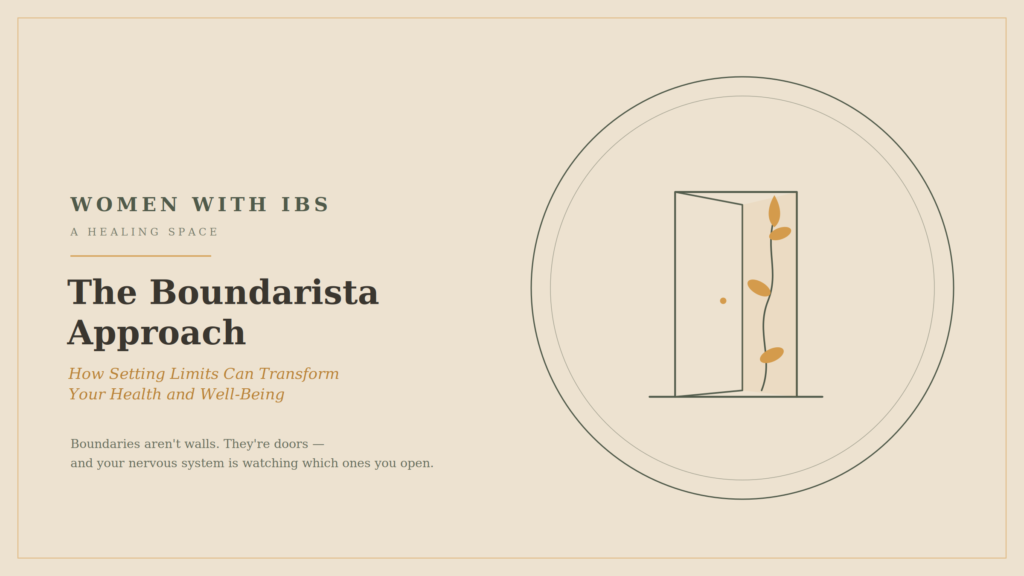
How Setting Limits Can Transform Your Health and Well-Being
There’s a woman I want to introduce you to. I call her a Boundarista. She protects her peace vigilantly, without apology, because she’s learned what it costs her when she doesn’t. She says no without a three-paragraph explanation attached. She lets toxic obligations go the way you’d let go of a hot pan. She is not selfish. She is, in the most literal medical sense, practicing prevention.
I want to be precise about that last claim, because I don’t make it lightly. Boundaries are not a self-care platitude. They are a physiological intervention. When you stop overextending yourself, something measurable happens in your body: your nervous system gets a signal it has likely been waiting years for. You are safe now. You can stand down. And a nervous system that finally believes it’s safe is a nervous system that can turn its attention to healing instead of bracing.
The fence nobody taught us to build
Let’s talk about the kind of boundaries nobody hands you a manual for. The ones that would have told you it was allowed to disappoint someone. If you were raised to be the fixer, the peacekeeper, the one who reads a room before she’s finished walking into it, you already know the cost. You’re likely exhausted in a way that sleep doesn’t touch. And if you’re a woman living with IBS, I’d bet money your body has been keeping tabs long before your mind caught up.
Most of us were taught the same curriculum early: put others first, keep the peace, carry what needs carrying, at home, at work, in every relationship that asked more of you than it gave back. Nobody called it a curriculum. It just looked like being good. But chronic self-suppression isn’t a personality trait. It’s a sustained physiological event, and your gut is one of the first places that event shows up.
Why your gut is the one keeping the receipts
Here’s the mechanism, and I want you to actually understand it, not just take my word for it. Your body has one nervous system, not two — there isn’t a “stress” version and a “digestion” version running in parallel. When you are in a chronic state of over-giving, over-functioning, or swallowing what you actually feel, your body reads that as ongoing low-grade threat. And a body that perceives threat does not prioritize digestion. It prioritizes vigilance. Blood flow shifts. Gut motility becomes erratic — too fast, too slow, or both on alternating days. The gut lining, sensitive as it is, becomes more reactive. This is not a character flaw or a fragile constitution. It’s a very old survival system doing exactly what it evolved to do, activated by a modern life that asks you to say yes to everything and call it love.
A boundary, physiologically speaking, is a signal of safety. Every time you decline something that costs you more than it gives you, you are telling your nervous system: the threat is over, you can come off high alert. Do that once and it’s a relief. Do it consistently and it becomes a pattern your body starts to trust, which is often where the real shift in symptoms begins.
What actually changes when you start setting them
Start with the body itself, because it already knows before your mind catches up. That clench in your stomach when someone asks you for something you don’t want to give, that’s not random. That’s data. Your gut is often the first place a “no” shows up, long before you’re consciously willing to say it out loud.
Let the guilt be there without obeying it. Guilt will show up right on schedule the first few times you disappoint someone you’re used to accommodating. Feeling it doesn’t mean you did something wrong; it means you’re doing something new. You are not responsible for managing everyone else’s disappointment. You’re responsible for your own health.
Think of boundaries as doors, not walls. A wall keeps everything out indiscriminately. A door is something you get to open and close on purpose, it lets in the relationships that feed you and closes on the ones that only ever extract. That distinction matters, because the goal was never isolation. It was discernment.
Practice the sentence before you need it, because “no” is a skill, not a personality trait, and skills get easier with repetition. Start smaller than feels necessary: I can’t take that on right now. That doesn’t work for me. I’m resting. No addendum required. A full sentence doesn’t need a legal defense attached to it.
And protect your energy the way you’d protect any other vital sign — because at this point, you understand it functions like one.
The invitation
Becoming a Boundarista isn’t about becoming harder or less generous. It’s about becoming someone whose generosity has boundaries around it, so it doesn’t quietly bankrupt her. Your body isn’t asking you to withdraw from your life. It’s asking you to stop financing it from an account that’s been overdrawn for years.
So tell me — what’s the one thing you’re saying no to today? Name it. Let that be the beginning.
This reflects general education about the nervous system, boundaries, and gut health, and is not a substitute for individualized medical care. It applies once serious and structural medical conditions have been appropriately evaluated and ruled out by your own clinician. If you are experiencing new, severe, or worsening symptoms, please seek medical evaluation. Please consult your own healthcare provider before making changes to your care.