Why your stomach might be the most honest part of you
Somewhere along the way, someone probably told you your stomach issues were “all in your head.” They meant it as a dismissal. What they didn’t realize is that they were, in a strange way, more right than they knew, just not in the way they meant it.
Your gut and your brain are not two separate systems that occasionally check in with each other. They are built from the same embryonic tissue, wired together by hundreds of millions of neurons, and in constant, two-way conversation for your entire life. Scientists call your gut the “second brain,” and that is not a poetic exaggeration. Your gut can sense, learn, and react largely on its own, and it is talking to your brain far more than your brain is talking to it.
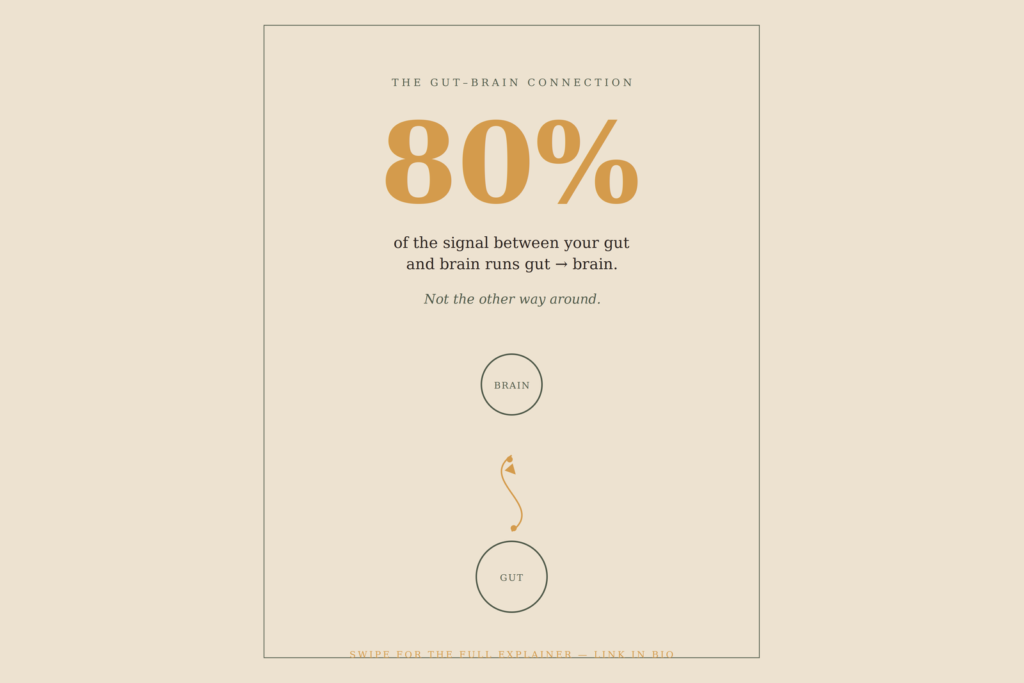
Here is the simplest way I can explain it: think of the vagus nerve as the phone line between your gut and your brain, and think of about eighty percent of the calls on that line as going from your gut up to your brain, not the other way around. Your stomach is not just receiving instructions. It is reporting in, constantly, about what it’s sensing, what it’s holding, and what state your body is in.
This is why chronic stress, unprocessed emotion, and a nervous system stuck in high alert don’t just live in your thoughts. They show up as real, physical signals in your gut: cramping, urgency, bloating, pain that has no clear anatomical cause. Your gut isn’t malfunctioning when this happens. It’s translating. It’s the only place left in your body still willing to tell the truth about what you’ve been carrying.
“Your gut isn’t malfunctioning. It’s translating.”
None of this means your pain is imaginary, and it doesn’t mean you can think your way out of it with positivity or a green smoothie. The nervous system doesn’t respond to willpower. It responds to safety, and safety is something you build slowly, through nervous system regulation, through finally letting yourself feel what you’ve spent years avoiding, through understanding your own story well enough that your body stops needing to shout to get your attention.
This was the piece I was missing for years. I had the medical training to rule out every serious diagnosis, and I still had no explanation for my own pain, because I was looking for it in the wrong system. Once I understood that my gut had been faithfully reporting on a nervous system that never got to rest, everything I thought I knew about my own body changed.
So the next time your stomach reacts to something before your mind has even caught up, consider this: what if that isn’t your body malfunctioning, but your body being the first to know?
KEEP GOING WITH ME
If this is the first time someone has explained the gut-brain connection in a way that actually made sense, you’re exactly who this platform is for. Follow along for more on the science of the mind-body connection, and if you’re ready to go deeper than a blog post can take you, my consulting and coaching work walks you through exactly how to start listening to what your body has been trying to say.
MEDICAL DISCLAIMER
This article is intended for educational purposes only and reflects a clinical and personal perspective on chronic gastrointestinal symptoms. It is not a substitute for individualized medical care. This framework applies once serious and organic medical conditions have been appropriately evaluated and ruled out by a qualified clinician. If you are experiencing abdominal pain, changes in bowel habits, unintentional weight loss, rectal bleeding, or any new or worsening symptoms, please consult your physician promptly.