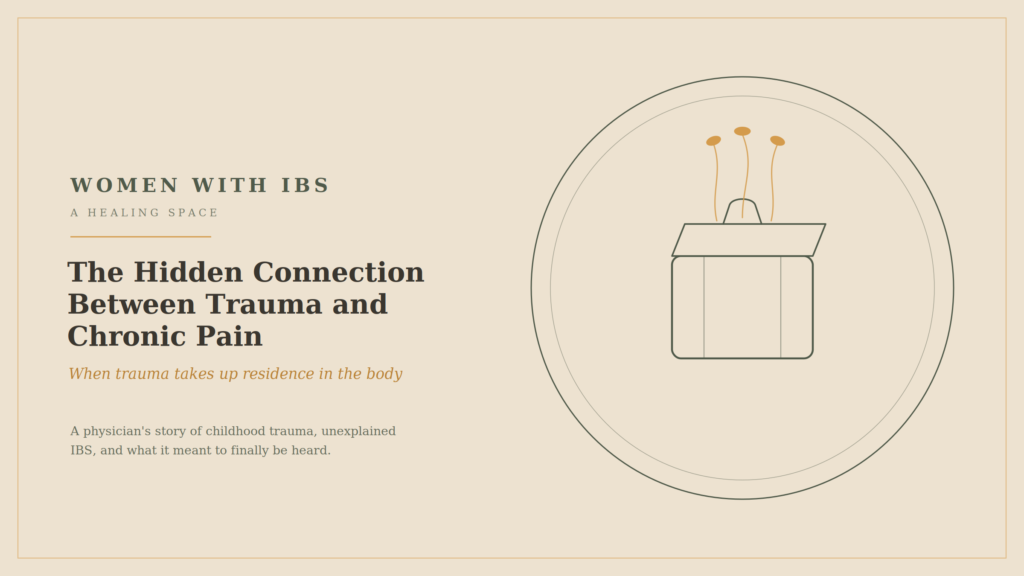
When Trauma Takes Up Residence in the Body
For years, I carried the weight of childhood trauma, rejection, and emotional neglect and I don’t mean that only emotionally. My body became the unwilling storage unit for years of suppressed fear, pain, and anxiety. If trauma were luggage, my gut was the overstuffed suitcase that never quite closed.
As a child, I experienced physical punishment, abandonment, and fear. And like so many of us do, I buried it. Out of sight, out of mind, that was the theory, anyway. It didn’t hold. While my mind worked hard to push those memories away, my body found another way to express them: debilitating gut pain and IBS.
I spent years moving from doctor to doctor, undergoing CT scans, colonoscopies, endoscopies, chasing a structural explanation for why my intestines felt like they were staging a rebellion. Every test came back clean. Nobody could find anything wrong with me, which somehow felt worse than finding something wrong.
The Diagnosis That Wasn’t a Diagnosis
“It’s just IBS.”
I heard some version of that sentence more times than I can count. Maybe you have too. You sit in a sterile office, vulnerable and hoping for relief, and you’re handed a label that sounds like an answer but functions more like a shrug. IBS, fibromyalgia, chronic fatigue syndrome — these terms often become placeholders for what a workup can’t otherwise explain. Translated honestly, it means: we can’t find a structural cause, but here’s a name for what you’re experiencing.
I want to be fair to that diagnosis, because as a physician I still use it, and I believe in it. IBS is real. What it isn’t, is a full explanation. It describes a pattern of gut dysfunction; it doesn’t tell you why the nervous system driving that dysfunction is on high alert in the first place. I left those appointments feeling unseen, even though every clinician in that room believed my pain was real. The message underneath the label was still: we don’t know why, so here’s a name for it and good luck.
The Nervous System Was the Missing Chart
The turn for me happened when I stopped treating my gut as the whole story and started asking what it might be a symptom of. I learned — first from my own training, and then from my own body — how chronic stress and unresolved trauma physically rewire the nervous system, keeping it locked in a state primed for threat long after the original threat is gone. For many of us, that rewiring doesn’t stay contained to the mind. It shows up as gut issues, migraines, chronic pain, autoimmune flares, the body speaking in the only language it has left when the original story never got processed.
One day, in a moment of pure frustration, I stopped obsessing over probiotics, elimination diets, and the next prescription to try. Instead I asked myself a different question: what if my gut wasn’t the problem? What if it was the messenger?
That question changed the direction of my entire recovery. A nervous system that has spent years bracing for the next blow, the next rejection, the next moment it wasn’t safe to feel, that nervous system doesn’t distinguish between a threat from thirty years ago and a threat from this morning. It just stays on. And a gut wired into a system that never stands down will, understandably, struggle to function like a gut that feels safe.
The Power of Being Heard
Something shifted when I started speaking my history out loud instead of only carrying it. Each time I told the truth about what happened to me, I noticed something in my body loosen not instantly, but unmistakably.
For years I had held memories of being hit, of being left alone, of crying myself to sleep in a dark room with no one coming. Those experiences shaped me in ways I didn’t fully understand until I said them out loud, not just to myself in the privacy of my own head, but to another person who could witness them. When I finally did, it felt like my body exhaled a breath it had been holding for decades.
Healing, I’ve come to believe, isn’t only about being treated. It’s about being heard. Those are not the same thing, and for a long time I only had access to the first one.
A Space for Your Story
This platform exists because of that difference. It’s a space where women can tell the truth about what their bodies have been carrying, and begin, from there, the slower work of healing.
If you’ve been holding your pain in silence, I want to invite you to put some of it down here. You don’t have to carry it alone, and you don’t have to have it all figured out before you speak.
Because when we speak, we start to heal. And when we listen to each other, we help someone else start healing too.
You are not alone in this. I hear you. We hear you. And together, we heal.
With understanding and compassion
Dr. Su
This reflects my personal experience and clinical perspective, and is intended for education, not as a substitute for individualized medical care. It applies once serious and structural medical conditions have been appropriately evaluated and ruled out by your own clinician. If you are experiencing new, severe, or worsening symptoms, please seek medical evaluation. Please consult your own healthcare provider before making changes to your care.